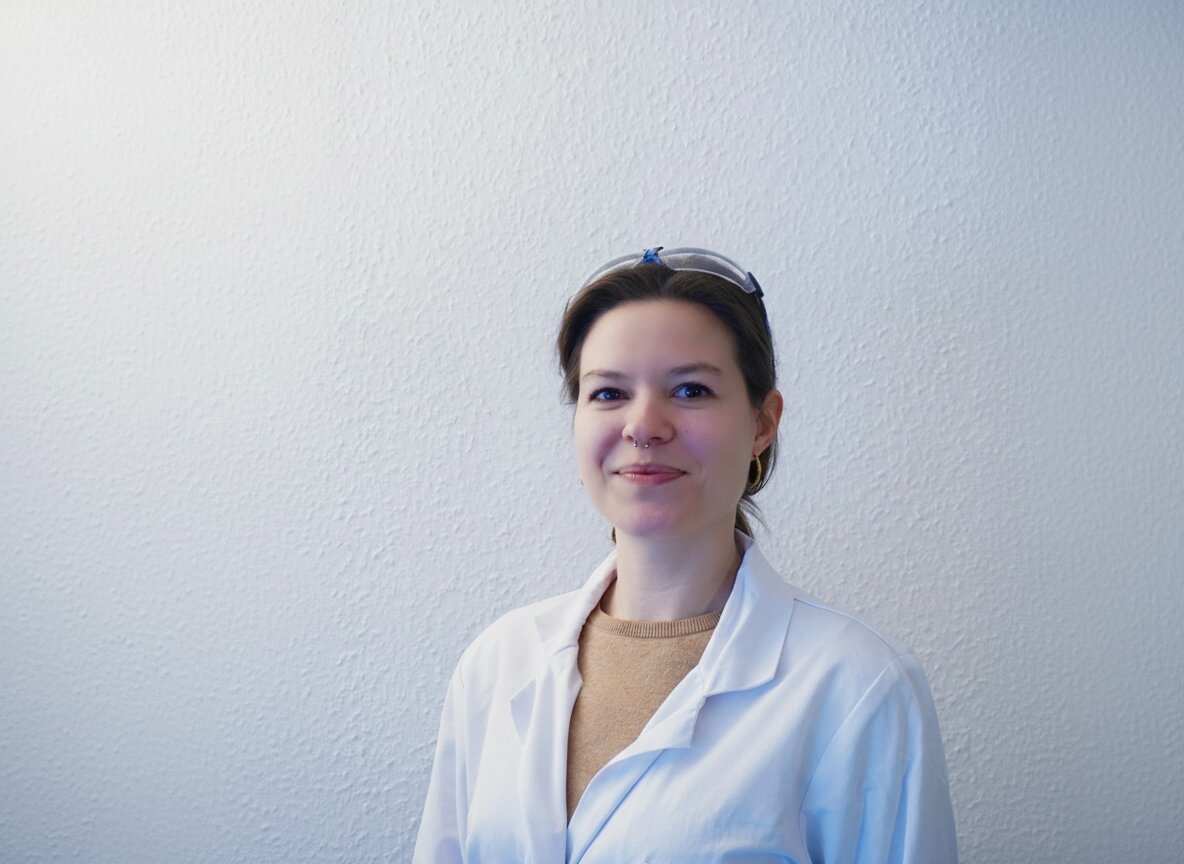
Digital transformation requires the right technology as a foundation, but it’s the people like Daniela Vogt who really drive it forward. Over her six years as a chemist at Marabu Inks, Daniela has worked across a wide range of technologies – from automotive coatings to screen printing inks, spanning both solvent-based and water-based systems. But what sets her apart isn’t just her technical expertise – it’s her deep passion for digitalization.
Daniela’s journey with Albert began almost by chance. “I was initially just filling in for a colleague,” she said. “But I quickly became very involved and have enjoyed it ever since. I love my fully digital workflow in Albert – it’s the future of R&D.”
Today, Daniela is one of Marabu’s most advanced Albert users and a true internal champion for digital R&D.
Daniela represents the ideal of a modern scientist. While many labs still rely on a hybrid of spreadsheets and shared drives, her workflow exists entirely within the Albert operating system (OS). “I don’t use Excel or Word anymore,” she explained. “Everything I do – formulation, notes, analysis – lives in Albert.”
Her process starts within Albert’s Excel-like spreadsheet module, where Daniela builds and manages her experiments – inputting raw materials, batch instructions, formulations, and results. She takes advantage of different functionalities, like collapsing grouped raw materials, color coding, or using the predecessor feature to track iterative versions of a formulation.
Daniela also likes using Albert’s block-based notebook in place of Word for recording protocols and daily updates. She especially likes using it as a collaborative space to pull together data and notes to share with colleagues.
But Daniela’s favorite part of the Albert OS is its built-in data visualization and reporting tool.
“I love using the reporting tool as a quick way to look through my results, like screening through gloss or surface tension data,” she explained. “It helps me see the most promising formulations clearly.”
She often filters the results in the reporting tool to identify the best candidates, then goes back into her experiment spreadsheet within Albert to explore them in more depth.
“I like to shrink it down to the most relevant information,” she said. “It’s a bit more difficult in Excel, but within Albert – with a few clicks, dragging and dropping – I can see everything I need. For me, it’s more intuitive.”
Daniela has even become the go-to resource for her colleagues when it comes to analyzing data in Albert – teaching others how to visualize their results and make faster, data-driven decisions.
Daniela’s digital workflows go beyond convenience – they change the quality of science and how R&D teams work together.
At the individual level, each scientist has a more holistic view of their work, ensuring data from older experiments or a different color of the same technology can easily be pulled into a new analysis. “You can compare all your data at once,” said Daniela. “In Excel, sometimes your results are saved across different spreadsheets and it’s hard to do a quick comparison. Now, I have a better view of all my work.”
At the organizational level, teams now work within a shared environment and standardized templates, making it easier to collaborate and compare results.
Because of scientists like Daniela, Albert becomes more than a tool. It becomes the foundation for Marabu to truly digitally transform and reshape materials innovation.
.png)



“Albert is fundamentally changing the way we have invented for over 145 years.”

.svg)
.png)