It's Monday afternoon, and a coatings chemist has a customer call on Wednesday. The customer wants an architectural paint that holds up to scuffs and chips in busy hallways. She's certain her company solved a version of this problem years ago, but the chemist who led that work has since retired.
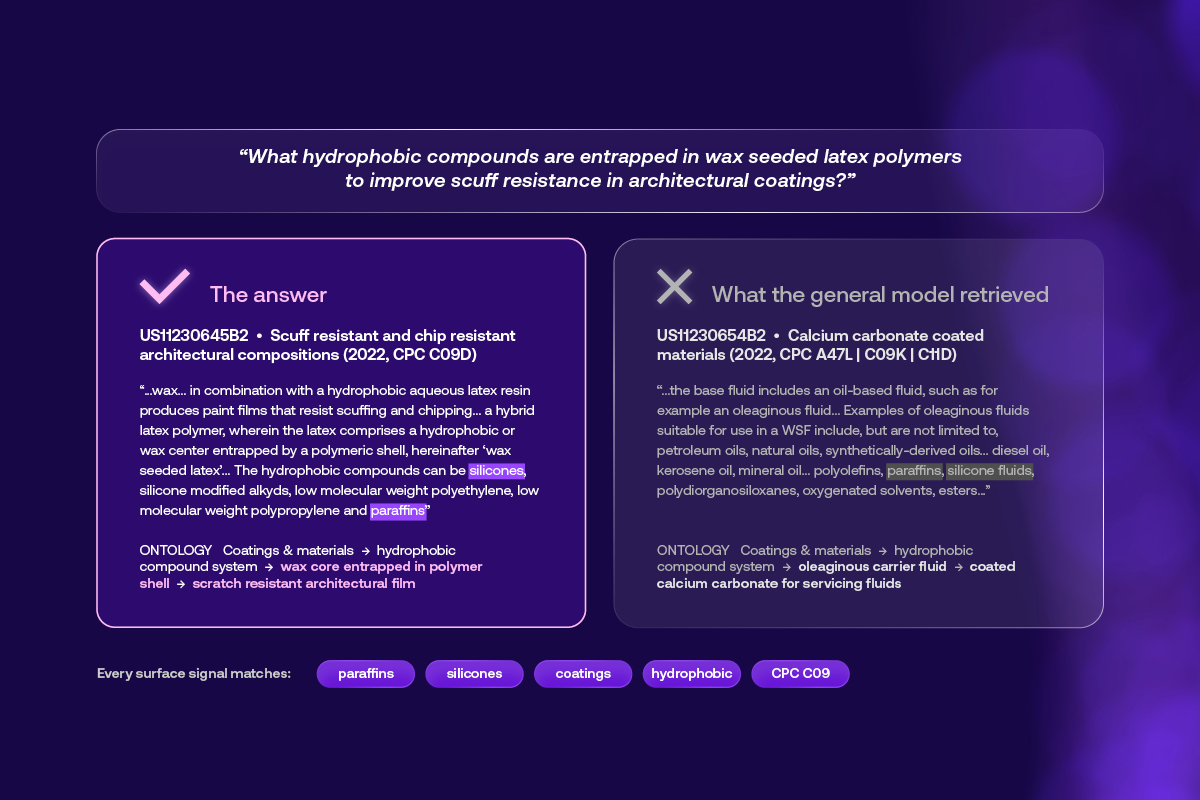
She asks the company's new AI search tool: Which hydrophobic compounds are entrapped in wax seeded latex polymers to improve scuff resistance? The answer comes back fast and includes terms that sound relevant, like paraffins and silicones. But something feels off, and after 20 minutes she figures out why. The passage the tool pulled describes oil-based carrier fluids for coated calcium carbonate, a completely different application that happens to use the same words.
After a few moments like this, most chemists lose trust and stop using the tool, and the AI investment that looked so promising in the pilot starts to look like a dead end.
But it doesn't have to be. Albert built Valence, a chemistry-native AI retrieval model that understands the complexities of R&D, so every answer earns a chemist’s trust and helps them invent faster. In new research, Valence proved 45x more accurate than general-purpose retrieval models at finding the right passage to answer scientific questions.
Where general-purpose AI breaks down
Most AI search tools run on general-purpose retrieval models. That's the part of the system that decides which passages move on to the next step, before the AI writes an answer. These models were built for breadth, and they're good at broad sorting, like telling a coatings document apart from a personal care document.
The harder job is the one chemists do every day: telling apart two passages from the same field that share vocabulary, material categories, and even patent classifications, but answer different questions. A senior formulation chemist makes that call in seconds, but a general-purpose model often can't make it at all.
The scenario above is drawn from a real query run against a real corpus. A leading general-purpose retrieval model ranked the correct passage beyond position 300 out of roughly one million, and put the wrong one at the top. Retrieval systems typically pass along only their top 100 or so results, meaning a right answer buried at position 300 is never seen. The model also gave the right and wrong passages nearly identical scores, suggesting it cannot tell meaningful differences between them.
The problem grows with scale. A tool that seems to work on a few hundred documents in a pilot can start returning plausible but wrong answers once it meets an enterprise knowledge base. In Albert's testing, some general-purpose models saw scores drop by more than 80% as the corpus grew toward one million passages. That pattern explains why so many R&D AI pilots look promising early on but then fail to produce real outcomes.
Putting a number on the gap
Our Head of AI, Jonathan Welch, set out to measure this gap with real rigor. Working with researchers from MIT and Reciprocal Space, he co-authored a recent study introducing FormBench, a benchmark built to test AI retrieval accuracy when answering questions around formulation science.
The study started with more than 590,000 US formulation patents spanning pharmaceuticals, adhesives, coatings, agrochemicals, food, and personal care. From there, the team built a corpus of roughly one million passages and more than 55,000 queries written the way a formulation chemist would ask them, each paired with the one passage that holds the answer.
The team then ran two tests to determine how well retrieval models could find those correct passages amongst competing, wrong passages. In the easy test, the wrong passages came from unrelated fields of chemistry. In the hard test, they came from the same field as the right answer: near misses that share vocabulary and classifications but differ in ways that matter to a chemist. The hard test is the one that mirrors life in the lab.
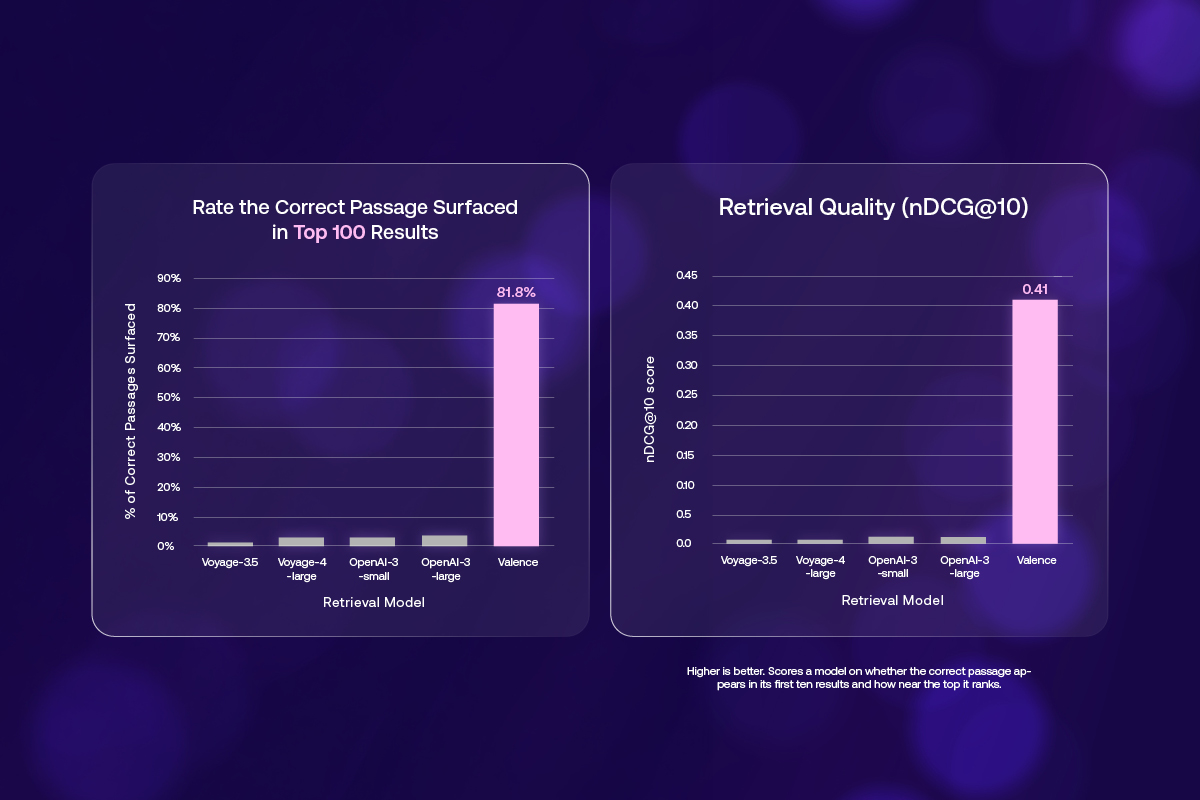
On the easy test, general-purpose retrieval models from OpenAI and Voyage did reasonably well. On the hard test, they found the correct passage in their top 100 results—the passages that move on to the next step in AI pipelines—only 2% to 4.5% of the time.
Valence, Albert's chemistry-native retrieval model, found it 81.8% of the time.
On a stricter measure, one that checks whether the correct passage lands near the very top of the first ten results, Valence scored 0.41 while the leading general-purpose model scored 0.009. That's roughly a 45x improvement (read more about the study here). And as the corpus grew toward one million passages, Valence held steady while general-purpose models fell off.
Why Valence can tell the difference
Valence was trained on tens of thousands of near-miss examples, pairs of passages that look alike on the surface but answer different questions. Through that training, it learned the signals a formulation chemist uses to tell them apart, like the role an ingredient plays and the application it's designed for.
General-purpose models squeeze every passage in a field into a narrow band of similar scores, leaving almost no difference between their first result and their hundredth. Valence spreads those passages apart, so the right answer rises to the top.
Built for chemistry from the ground up
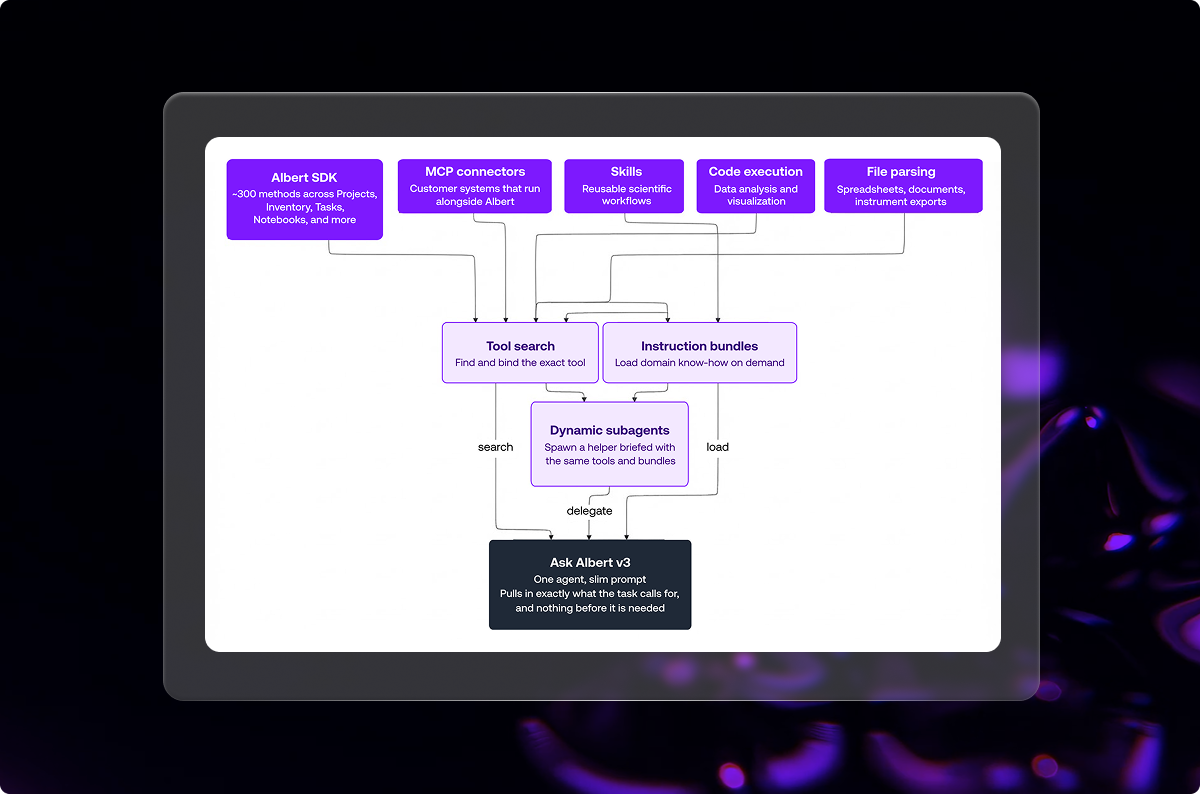
Valence is the retrieval engine behind Ask Albert, our agentic AI that orchestrates the tools, agents, and models to surface knowledge and execute tasks within Albert OS. Valence works across the chemical industry from day one, and it can be tuned on a company's own documents to learn that team's specific chemistry, with enterprise-grade security and zero data retention. It’s also just one layer to an entire system built for chemistry from the ground up, including an underlying data ontology that structurally represents R&D, a reasoning engine that understands how different types of R&D data relate to one another, and reasoning audit trails.
So, what does that mean for the chemist preparing for Wednesday’s call? This time, with Ask Albert and Valence at her fingertips, she asks her question and gets the passage that answers it, with a reasoning audit trail to back it up. Twenty minutes of second-guessing becomes a few seconds of confirmation, and she gets back to the work only she can do.
Want to see how Ask Albert performs on your knowledge base, and what tuning could look like for your chemistry? Talk to our team.





“Albert is fundamentally changing the way we have invented for over 145 years.”


